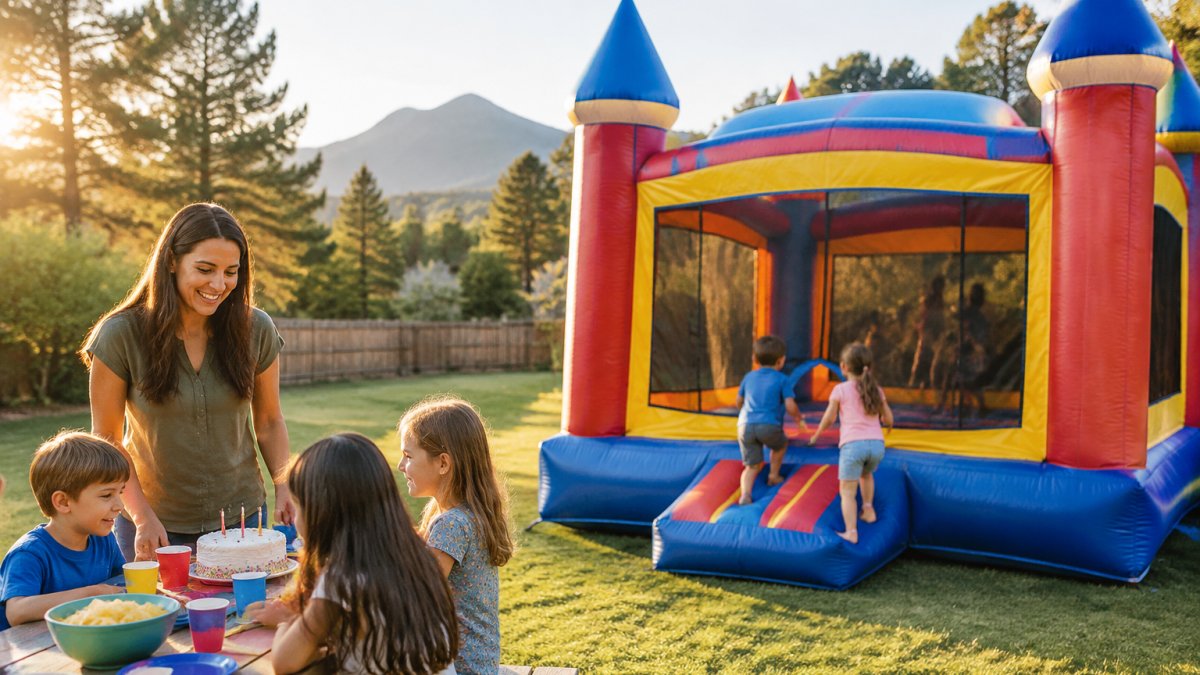
 comparison
Bounce House vs Inflatable Obstacle Course for School Events
Last Updated: November 5, 2026
Quick Summary
A bounce house suits younger children and smaller groups because it is a contained jumping space with a smaller footprint, while an inflatable obstacle course fits older students and large gatherings with racing, climbing, crawling, and sliding. Choose by age and space: bounce house for ages 5 to 8, obstacle course for upper elementary and up.
- A bounce house holds a small group jumping together, with sessions of roughly 5 to 7 minutes per group.
- An obstacle course runs one racer at a time, roughly 30 to 50 runs per hour per lane.
- For a 240-student, 90-minute block, split into two halves of 120 and switch stations after about 40 minutes.
- Assign one adult to manage shoes and one to give rules before each group to boost capacity.
- Evacuate any inflatable when winds get strong, no exceptions, especially with Northern Arizona gusts.
Table of Contents
- Bounce House vs Inflatable Obstacle Course: The Quick Comparison
- Best Option by Age Group: Bounce House Age Recommendations
- Space and Setup: Inflatable Obstacle Course Space Requirements
- Guest Flow and Throughput: Moving a Whole School Through the Line
- Planning School Field Day Inflatable Rentals Around Your Schedule
- The Inflatable Rental Safety Checklist for School Events
- Where Each Inflatable Wins: A Decision Framework for School Scenarios
- Book Your School Event Inflatables Early
- Frequently Asked Questions
Bounce House vs Inflatable Obstacle Course: The Quick Comparison
Choosing between a bounce house versus an inflatable obstacle course for school events comes down to one question: are you entertaining a group that wants to bounce in place or race from start to finish? A traditional bounce house is a contained jumping space that suits younger children and smaller groups. An inflatable obstacle course is a linear, high-energy activity built for older students and large gatherings. At Flagstaff Party Central Inflatables, we know that the right pick almost always follows the age of your students and the size of your space.
Here is the short version:
| Factor | Bounce House | Inflatable Obstacle Course |
|---|---|---|
| Best age range | Younger children | Older students |
| Group size fit | Small groups | Large gatherings |
| Footprint | Smaller footprint | Longer setup area |
| Activity style | Open-ended play | Racing, climbing, crawling, sliding |
| Participant flow | Free jumping, easy turn-taking | One-at-a-time throughput |
| Supervision needs | Constant eyes on the jumpers | Spotters at entry and exit |
| Budget fit | Generally more affordable | Higher rental cost |
Both options deliver engagement and entertainment. The difference is how they process participants and how much room they need.
Best Option by Age Group: Bounce House Age Recommendations
For younger children, a bounce house wins nearly every time. Kids roughly ages 5 to 8 jump for the joy of jumping.
Older students want a challenge. Once kids hit upper elementary and middle school, a straight bounce loses its shine fast. An inflatable obstacle course gives them racing, climbing, crawling, and sliding, plus the friendly competition that keeps a crowd coming back for another run.
The tricky part is mixed-age groups, where splitting the crowd into separate zones often works best. Our guide to party rentals for mixed age groups breaks down how to split the space.
Bounce house age recommendations at a glance:
- Ages 3 to 5: small bounce house with low walls and soft landing
- Ages 5 to 8: standard bounce house, the sweet spot
- Ages 9 to 12: obstacle course or interactive games
- Ages 12 and up: obstacle course, racing format, or team challenges
Space and Setup: Inflatable Obstacle Course Space Requirements
Inflatable obstacle course space requirements start with length, not width. An obstacle course runs in a straight line, so you need a long, flat, clear stretch of grass or pavement plus room for the blower and safe entry and exit.
Before you book, walk your site and check these items. Treat this as a usable site-readiness checklist you can hand to your principal or facilities manager:
- Dimensions: Measure the actual setup area, not the field. Confirm the length and width your rental company needs for the specific unit, plus a buffer for the blower and entry/exit paths.
- Surface: Flat grass, blacktop, or gym floor. Note slopes, sprinkler heads, rocks, and drainage grates.
- Anchoring: Stakes work on grass; sandbags or weights are needed on hard surfaces. Confirm which your site allows.
- Overhead clearance: No low branches, power lines, or gym ceiling obstructions. Gyms have ceiling clearance limits, so measure before you assume an inflatable fits indoors.
- Power access: A nearby outlet for the blower, or ask about generator options. Confirm the circuit can handle the load and that cords will not cross walkways.
- Entrances and exits: Clear paths for students to reach the inflatable and for emergency access.
- Clearance around the unit: Space for spotters to stand and for the next group to wait without crowding the entry.
School fields, blacktops, and gymnasiums all work, but each has quirks worth planning around. Grass gets muddy after a Northern Arizona monsoon, so check the forecast and have a backup surface.
Fit the setup into the school day, not the other way around. Delivery and setup take time, and the first bell does not wait. If you are unsure who handles the heavy lifting, read up on whether party rental companies handle setup and takedown.
Watch out: a site that looks flat from the parking lot can hide a slope or a sprinkler head that ruins anchoring.
Guest Flow and Throughput: Moving a Whole School Through the Line
Throughput is the number most event planners forget, and it decides whether your inflatables stay fun or turn into a wait-time complaint line.
Here is the part most comparison articles skip: a transparent way to estimate how many students each inflatable can actually process in an hour.
Bounce house throughput assumptions:
- A standard bounce house holds a small group jumping together at one time.
- Assume a jump session of roughly 5 to 7 minutes per group.
- Add 1 to 2 minutes for shoe removal, entry, and exit between groups.
- That works out to roughly 6 to 9 groups per hour, depending on how tightly you run the line.
Obstacle course throughput assumptions:
- An obstacle course runs one racer per run in a single lane.
- Assume a run time of roughly 45 to 90 seconds for an elementary-age student, longer for older or hesitant kids.
- Add 15 to 30 seconds for the next racer to enter and the previous one to clear the exit.
- That works out to roughly 30 to 50 runs per hour per lane, again depending on age and confidence.
Those two ranges are not directly comparable. A bounce house processes a group at a time; an obstacle course processes individuals faster but with a hard one-at-a-time ceiling. For a large field day, run two obstacle course lanes or pair an obstacle course with a bounce house so one group races while the other jumps.
A worked rotation example. Say you have 240 students and a 90-minute activity block. If you run one bounce house and one obstacle course side by side, split the students into two halves of 120.
Watch out: the biggest throughput killer is not the inflatable itself, it is unstructured shoe removal and safety briefings at the entry.
Planning School Field Day Inflatable Rentals Around Your Schedule
School field day inflatable rentals work best when you build the schedule around class rotations, not the other way around. Instead of one giant free-for-all, assign each class a time slot and rotate stations every 15 to 20 minutes. Teachers stay with their class, and your inflatables never get swarmed.
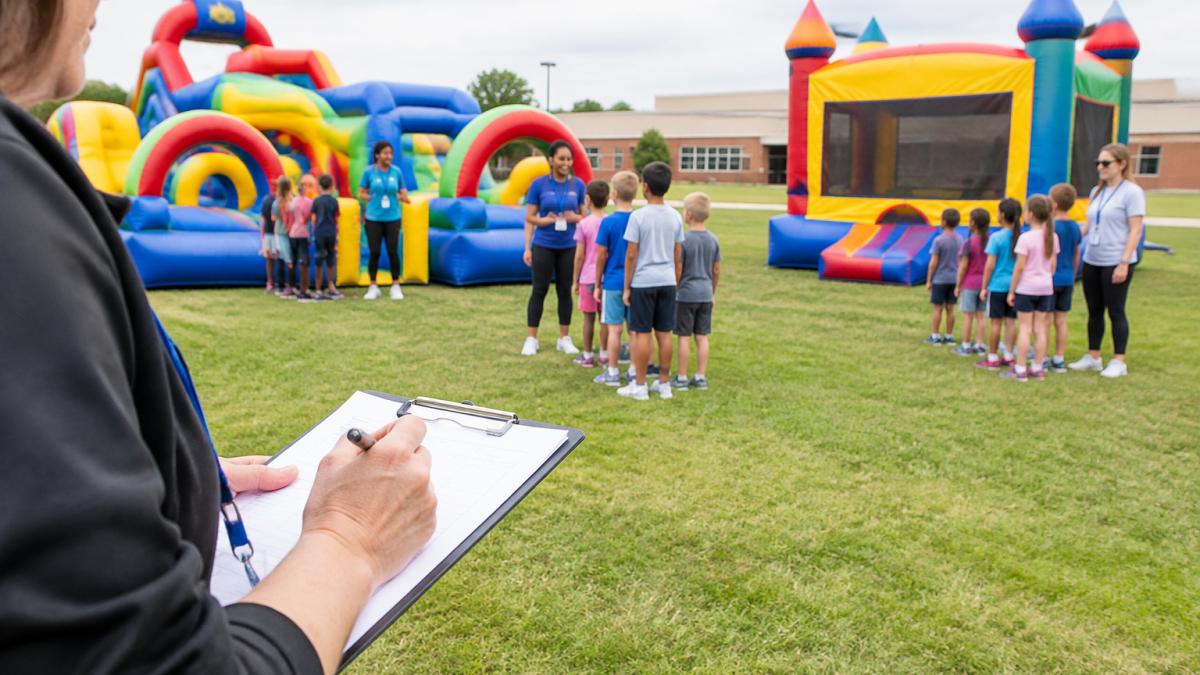
A rotation that works well:
- Class arrives and lines up by station
- Students rotate through the obstacle course, bounce house, and field games
- A whistle signals the switch to the next station
- Classes cycle through until every group has had a turn
Build in extra time for recess and lunch so the schedule does not collapse when a class runs late. Share your rotation plan with your rental company when you book; it helps them time delivery and setup before the first bell. For a deeper look at school-appropriate course options, browse the best obstacle course rentals for schools.
The Inflatable Rental Safety Checklist for School Events
Safety comes down to supervision, anchoring, and knowing who you are renting from. A proper inflatable rental safety checklist protects students and gives staff clear jobs on event day.
- Confirm the provider carries insurance and is approved to operate on your property
- Verify anchoring: stakes on grass, sandbags or weights on hard surfaces
- Assign one adult spotter per inflatable at all times
- Set rules: no shoes, no food, no flipping, one direction only
- Check the blower stays connected and inflated throughout
- Keep a first-aid station and water nearby
- Have a plan to stop activity if winds pick up
That last point matters in Northern Arizona, where afternoon gusts roll in fast. For a full walkthrough, read how to ensure bounce house safety at your party and our 7-step checklist to verify bounce house safety before you sign a rental agreement.
Watch out: be cautious of operators with prices that look too good to be true, and ask any company for proof of insurance and approval to operate on school property before booking.
Where Each Inflatable Wins: A Decision Framework for School Scenarios
Use this framework to match the inflatable to your specific event. The choice is rarely about which is "better" in general; it is about which fits your students, space, and goals.
- Preschool or early elementary fun day: Bounce house. Younger children want simple, contained play.
- Upper elementary field day: Obstacle course, or a combo with both.
- Middle school reward event: Obstacle course for the competition and energy.
- Large all-school carnival: Both, split into zones, to spread the crowd.
- Tight venue or small courtyard: Bounce house, thanks to its smaller footprint.
- High-energy group needing a challenge: Obstacle course every time.
If your group is older and you are leaning toward a course, our team can help you weigh obstacle course options built for schools. And when you are ready to lock in equipment, book your school event rentals early, because spring field day dates fill fast.
Book Your School Event Inflatables Early
The best school events are the ones where the inflatables show up on time, get set up before the first class arrives, and never leave teachers scrambling. That is the part we handle. Flagstaff Party Central Inflatables has been locally owned and operated since 2007, we are the only party rental company approved by the City of Flagstaff for city parks and property, and we have provided kid zones for the largest family events in Flagstaff since 2011. Whether you need a bounce house for the little ones or an obstacle course for the big kids, we deliver, set up, and tear down so your staff can focus on the students.
Frequently Asked Questions
Is a bounce house or an inflatable obstacle course better for a school event?
It depends on the students and the schedule. A bounce house suits younger children and smaller groups, with simpler setup and a smaller footprint. An inflatable obstacle course fits older students and high-energy field days, and it keeps participants moving so lines turn over faster. Many schools rent both and split them by grade level so every age group gets an activity that fits.
What age is recommended for a bounce house?
Bounce houses work best for younger children, roughly preschool through early elementary, because the bouncing is simple and easy to supervise. Older students often lose interest quickly in a plain bounce house. If your event mixes ages, pair a bounce house for the younger kids with a separate activity for the older ones so nobody feels the equipment is too babyish.
How much space does an inflatable obstacle course need at a school event?
Obstacle courses are longer than bounce houses, so they need a clear, flat run with room to enter and exit safely. Exact dimensions vary by unit, so ask your rental company for the footprint of the specific course you are considering and measure your setup area before booking. Leave extra room for the entrance line and a buffer from fences, trees, and pavement.
How can schools manage student lines and turns on inflatables?
Use timed turns, a single-file line with a teacher or volunteer at the entrance, and a posted schedule by class. Obstacle courses process kids faster because participants move through rather than staying in one spot, which shortens wait times. For bounce houses, cap the number of kids inside at once and rotate every few minutes so everyone gets a turn during the event window.
What should a school check before renting an inflatable?
Confirm the company is insured and approved for the venue, ask who handles setup and takedown, and get the unit dimensions in writing so you can match them to your space. Check the safety checklist: flat ground, secure anchoring, clear entrance and exit, and adult supervision at all times. A legitimate local company will answer these questions without hesitation.