 how-to
How to Verify Bounce House Safety: 7-Step Checklist
Last Updated: October 23, 2026
Quick Summary
To verify bounce house safety, walk the entire unit before anyone jumps: check vinyl for holes and split seams, confirm netting is snug and entrance mats are in place, test the blower, and hand-check every anchor. Then confirm level ground, overhead clearance, and a written wind shutdown rule with your vendor.
- A full pre-use bounce house safety check takes about ten minutes.
- Push down on each corner by hand; if it lifts, the anchor is not set.
- Shut the unit down at the first sign of strong wind, thunder, rain, or dust.
- Ask vendors for a certificate of insurance and inspection records before paying a deposit.
- If an inspection fails, stop setup, document the problem, and call the vendor.
Table of Contents
- Start With a Pre-Use Inspection Before Anyone Jumps
- Check Holes, Tears, and Seams in the Vinyl
- Inspect Netting, Entrances, and Safety Mats
- Your Bounce House Safety Checklist for Setup Day
- Verify the Blower, Airflow, and Power Cord Setup
- Confirm Anchoring: Stakes, Sandbags, and Clearance
- Bounce House Wind Safety and Weather Shutdown Rules
- Bounce House Age and Weight Limits: Who Can Jump?
- Bounce House Rental Safety Questions to Ask Before Booking
- What to Do When an Inspection Fails
- Frequently Asked Questions
Start With a Pre-Use Inspection Before Anyone Jumps
Learning how to verify bounce house safety starts with one habit: walk the whole unit before the first kid takes off their shoes. A bounce house safety check takes about ten minutes.
At Flagstaff Party Central Inflatables, we have been setting up inflatables around Northern Arizona since 2007.
Below, we break down the exact checks we run, plus the questions to ask any rental vendor before you book.
Check Holes, Tears, and Seams in the Vinyl
Holes, tears, and split seams are the first thing to hunt for. Run your hands along the vinyl, especially near the entrance and the floor. Small punctures grow under jumping weight.
Look for:
- Pinholes or scuffs that let air escape
- Stretched or frayed seams along the walls
- Loose stitching at stress points
A slow leak shows up as a unit that sags within minutes of inflation. Per U.S. Consumer Product Safety Commission guidance on inflatable amusement rides, damaged inflatables should never be used until repaired.
Inspect Netting, Entrances, and Safety Mats
Netting keeps jumpers inside. Entrances and safety mats keep them from landing hard. All three deserve a close look.
Check that the netting has no rips and stays tight against the frame. Loose netting lets kids slip through gaps. Then check the entrance: a proper safety mat or step should sit at the opening so kids don't trip climbing in.
- Netting: no tears, snug to the frame
- Entrance: mat or step in place, no gaps
- Safety mats: flat, not bunched or missing
If the netting sags or the mat is missing, ask the vendor to fix it before setup finishes.
Your Bounce House Safety Checklist for Setup Day
Here is the bounce house safety checklist we run on every delivery. Use it whether you rent or inspect your own unit.
| Check | What to Look For | Why It Matters |
|---|---|---|
| Vinyl surface | No holes, tears, or worn spots | Prevents sudden deflation |
| Seams | Tight stitching, no fraying | Holds shape under weight |
| Netting | Snug, no rips | Keeps jumpers inside |
| Entrance and mats | Mat present, flat, secure | Reduces trip and fall risk |
| Blower and cord | Running, cord out of walkways | Keeps steady airflow |
| Anchoring | Stakes or sandbags set on all corners | Stops tipping and sliding |
| Clearance | Open space around all sides | Prevents collisions with objects |
| Capacity label | Visible and readable | Sets safe jumper count |
Print it, screenshot it, or keep it on your phone. A repeatable checklist beats memory every time.
Verify the Blower, Airflow, and Power Cord Setup
The blower is the engine of the whole unit. If airflow drops, the walls go soft and the bounce surface loses its spring.
Listen to the blower at startup, steady, with no rattling or grinding. Feel the unit: walls firm, floor taut, not sagging.
Then trace the power cord:
- Cord plugged into a grounded outlet
- Cord routed away from walkways and grass where kids run
- No frayed wires or taped splices
Never run a blower on an extension cord that's too light for the job, and never let the cord cross a jumping path.
Confirm Anchoring: Stakes, Sandbags, and Clearance
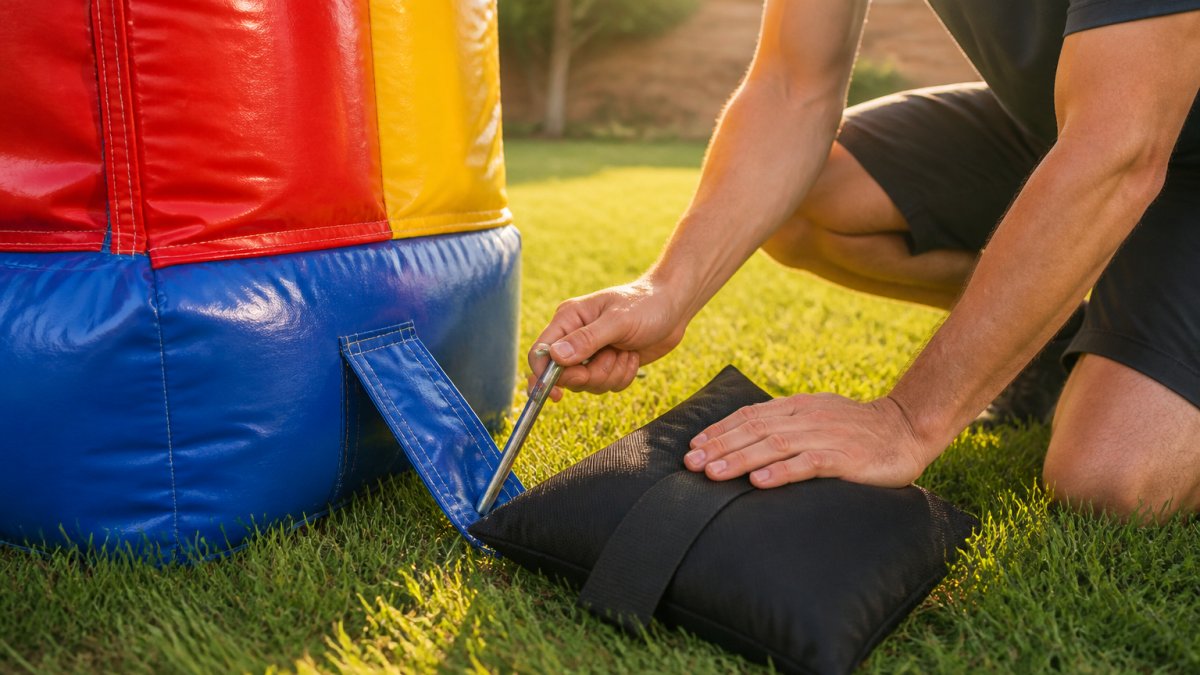
An unanchored bounce house is a kite waiting for a gust. Every corner needs a stake or sandbag, checked by hand. But where the unit sits matters as much as how it's tied down, the part most checklists gloss over.
Anchor checks you can do by hand
Push down on each corner. If it lifts, the anchor isn't set. Stakes should drive deep and hold firm when you tug the strap; sandbags should sit heavy and flat, not dangling. On pavement, sandbags are the only option, so confirm the vendor brings enough for every anchor point, not just the corners.
Site-specific setup hazards to check before the unit goes up
Walk the spot before anything inflates and look for these:
- Overhead power lines. The unit, the blower, and anyone on top of it need clear vertical clearance from lines. If the only flat spot in the yard sits under a service drop, pick a different spot.
- Slopes. Inflatables want level ground. A noticeable slope shifts weight to one side, stresses the anchors, and makes the jump surface uneven. If the yard tilts, ask the crew to reposition rather than "making it work."
- Hard surfaces. Concrete, asphalt, and pavers don't take stakes, and a fall onto them is far less forgiving than grass. Sandbags and a mat are the minimum; a softer location is better.
The clearance and placement checklist
| Check | Pass criteria |
|---|---|
| Overhead lines | Clear vertical space above the unit and blower |
| Ground slope | Level enough that the unit sits even under load |
| Surface | Grass preferred; sandbags and mat if hard ground |
| Underground | Sprinklers, septic, gas, and electrical located and avoided |
| Debris | No rocks, roots, or sharp objects under the mat |
| Sides | Open buffer to fences, trees, walls, and furniture |
| Blower and cord | Outside the jumping zone, cord out of walkways |
If the only spot that fits the unit fails one of these checks, the right move is to move the unit or reschedule, not to hope. A crew that knows what they're doing will say the same thing.
Bounce House Wind Safety and Weather Shutdown Rules
Bounce house wind safety comes down to one rule: when the wind picks up, shut it down. No exceptions.
Watch the forecast before setup and the sky all day, Flagstaff weather turns fast, especially in monsoon season.
Common shutdown triggers include:
- Strong, steady wind that pushes the walls
- Sudden gusts that rock the unit
- Thunder, lightning, or rain
Lightning is an automatic stop. The National Weather Service lightning safety guidance is clear that outdoor activities should stop at the first sign of thunder.
Bounce House Age and Weight Limits: Who Can Jump?
Bounce house age and weight limits protect the smallest and biggest jumpers alike. Check the capacity label before anyone climbs in.
Most units post occupant and weight limits on a label near the entrance. Read it out loud, then group kids by size and age so toddlers aren't bouncing with bigger kids.
- Toddlers: separate session, close supervision
- Young kids: group by similar size
- Older kids: check the weight limit before they join
Crowding is the most common cause of collisions. Cap the number of jumpers, rotate them in waves, and remove shoes, jewelry, and anything sharp before entry.
Bounce House Rental Safety Questions to Ask Before Booking
Bounce house rental safety questions separate a real vendor from a fly-by-night operation. But the right questions aren't just conversation starters, they're a documentation request.
So before you pay a deposit, ask for the following items and actually look at them.
The documentation to request
- Certificate of insurance. Ask for a current certificate showing general liability coverage and confirm the name on it matches the company you're booking. A vendor who "has insurance" but can't produce a certificate is telling you something.
- Inspection records. Ask whether units are inspected before each rental and whether they keep a log. You don't need to audit the whole file, but a company that tracks inspections can usually describe the process in specific terms.
- Manufacturer operating instructions. Every inflatable ships with setup, anchoring, and wind-limit guidance from the manufacturer. Ask whether the crew follows it. A vendor who shrugs at this question is improvising.
The operational questions
Once the paperwork checks out, ask how the day will actually run:
- Do you handle setup, anchoring, and takedown, or is that on me?
- How many anchors do you bring, and what type, stakes, sandbags, or both?
- What's your wind shutdown policy, and who makes the call to deflate?
That last one matters more than it sounds. A good crew gives you a two-minute orientation at setup: the entrance, the jumper rating, the wind triggers, and how to reach them mid-event. If nobody offers it, ask.
Red flags worth walking away from
Be wary of operators who skip city approval or lack proper insurance. These can be red flags, as they may cut corners on anchoring, blower safety, and cleaning. Other red flags include no written agreement, no certificate on request, evasive answers about inspections, and too few anchors for the unit.
Flagstaff Party Central Inflatables is the only party rental company approved by the City of Flagstaff for city parks and property.
What to Do When an Inspection Fails
When an inspection fails, stop the setup and fix it before anyone jumps. Don't talk yourself into "it's probably fine."
Here's the order we follow:
- Stop. Keep everyone off the unit.
- Document. Snap a photo of the problem.
- Call the vendor. Report the issue right away.
- Fix or replace. A torn seam or dead blower means the unit comes down.
- Re-inspect. Run the full checklist again before use.
If the vendor can't fix it, ask for a replacement unit or a refund.
For rentals in and around Flagstaff, our team handles setup and takedown, so you're not stuck diagnosing a blower on party day. We deliver throughout Northern Arizona and the entire state.
Frequently Asked Questions
How can I tell if a bounce house is safe before renting it?
Ask the rental company how they inspect equipment between events, whether their inflatables meet current ASTM safety standards, and if they carry liability insurance. When the unit arrives, walk the perimeter yourself: look for tears, check that netting is intact, confirm the blower runs continuously, and make sure stakes or sandbags are secure. A reputable vendor will welcome these questions and may even walk you through their own bounce house safety checklist before setup is complete.
What wind speed is unsafe for inflatables?
Most inflatable manufacturers set a shutdown threshold around 15 to 20 mph sustained wind, and many rental agreements require the blower to be turned off if gusts reach that range. In Flagstaff, afternoon gusts can spike quickly, so check the forecast the morning of your event and keep an eye on the sky. If wind picks up, clear the unit immediately and wait for conditions to settle. Never try to hold a bounce house down with extra people or weight during high wind.
Are bounce houses safe for 3-year-olds?
Yes, with the right setup. Toddlers should use a smaller unit or a dedicated toddler zone, jump separately from bigger kids, and have an adult within arm's reach at all times. Confirm the manufacturer's minimum age on the capacity label, remove shoes and jewelry, and limit the number of jumpers to what the label allows. Mixing a 3-year-old with 10-year-olds is where most collisions and injuries happen, so group by size and age.
What should I ask a bounce house rental company about safety?
Ask these bounce house rental safety questions: Are you insured and approved to operate in the city where my event is held? How often is equipment inspected and cleaned? Do you provide setup and takedown, or is that on me? What happens if the blower fails or the unit is damaged during my event? And what are your wind and weather policies? A company that answers clearly and in writing is usually the one you want handling your party.
Planning a party and want equipment you can trust? Flagstaff Party Central Inflatables brings the bounce houses, water slides, obstacle courses, and event gear, with delivery, setup, and takedown handled by our team. We've been locally owned since 2007 and approved by the City of Flagstaff for city parks. Order online today and lock in your date before the busy season fills up.