 listicle
What Are the Best Obstacle Course Rentals for Schools?
Last Updated: November 2, 2026
Quick Summary
The best obstacle course rentals for schools are compact single-lane courses for younger grades, standard dual-lane courses of 30-40 feet for most K-8 field days, and long multi-element courses of 50 feet and up for middle and high school events. Match course length to your space, student count, and age group, and reserve popular spring field day dates early.
- Divide the field into zones and rotate each class every 15 to 20 minutes to keep lines short.
- Two mid-size courses running side by side often beat one giant unit for crowd flow.
- Kindergarten through second grade do best with compact courses featuring gentle climbs and wide crawl tunnels.
- Ask for a certificate of insurance naming the school or district as additional insured before signing.
- Schedule delivery at least an hour before students arrive and keep takedown clear of dismissal.
Table of Contents
- Why Obstacle Course Rentals Beat Every Other Field Day Attraction
- Quick Comparison: Obstacle Course Options for Schools
- How to Plan a School Field Day Around Your Inflatable Rentals
- School Field Day Rentals: Age-Appropriate Course Selection
- The Obstacle Course Rental Safety Checklist Every School Needs
- Inflatable Rentals for School Events: Delivery, Setup, and Power Logistics
- How to Vet an Obstacle Course Vendor Before You Sign
- Reserve Your Obstacle Course Rental for the Next School Event
- Frequently Asked Questions
Why Obstacle Course Rentals Beat Every Other Field Day Attraction
Ask any PE teacher what actually gets kids moving at a field day, and you'll hear the same answer: a course they have to run, climb, and crawl through.
A bounce house entertains a handful of kids while everyone else waits, while an inflatable obstacle course can move participants through in a steady stream.
Below, we'll walk through the options, safety checks, logistics, and vendor questions that separate a smooth event from a stressful one.
Quick Comparison: Obstacle Course Options for Schools
Course length drives almost every planning decision, so start there. Shorter units fit tight spaces and younger students; longer courses deliver more challenge for upper grades and bigger crowds.

| Course Type | Typical Length | Best For | Space Needed | Throughput |
|---|---|---|---|---|
| Compact single-lane | Around 20 feet | Younger grades, tight footprints | Small field or blacktop | Steady, one at a time |
| Standard dual-lane | 30-40 feet | Most K-8 field days | Medium field | Two racers side by side |
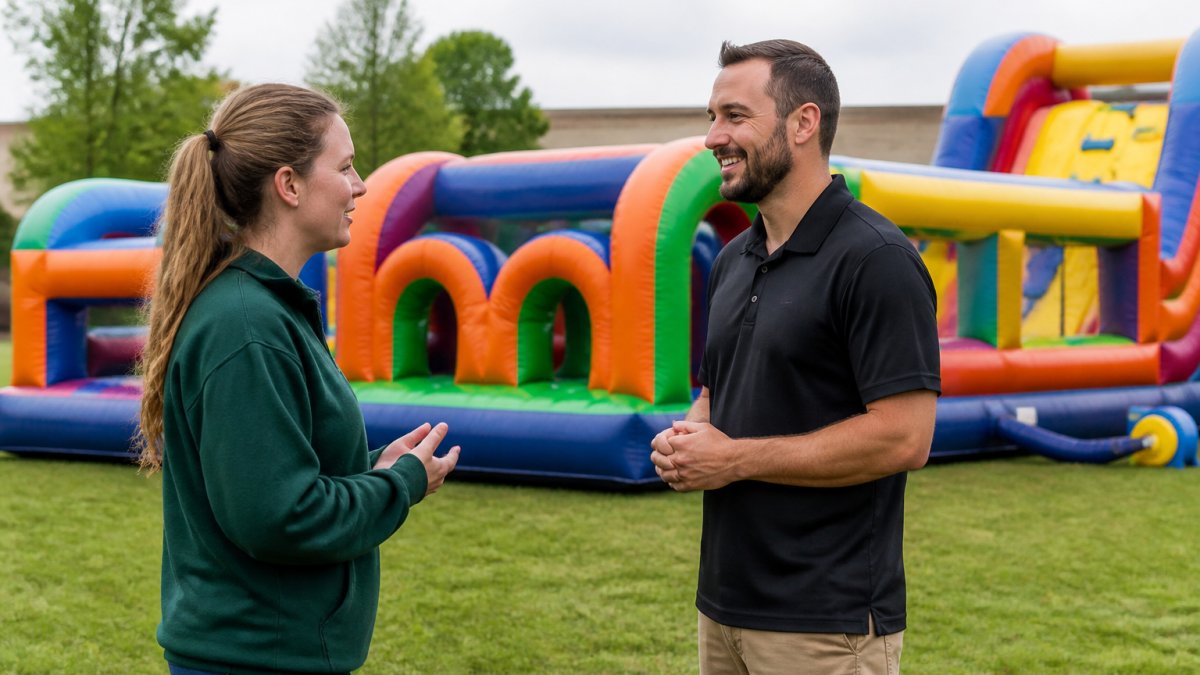
| Long multi-element | 50 feet and up | Middle and high school events | Large open field | Highest volume |
| Wet/dry combo | Varies | Warm-weather carnivals | Field with drainage | High, with water play |
Pricing depends on course length, rental duration, delivery distance, and date. Popular spring field day dates can fill up, so reserve early. Our bounce house rental pricing guide breaks down the factors that shape a quote.
How to Plan a School Field Day Around Your Inflatable Rentals
Planning a school field day starts with the schedule, not the equipment. Map your grade-level rotation first, then choose obstacle course rentals that fit each time slot and space.
A common approach is station rotation: divide the field into zones, assign each class a starting point, and rotate every 15 to 20 minutes.
- Confirm your date with the school office and check the calendar for conflicts
- Walk the field and mark off zones for each station
- Set a rotation schedule by grade level
Flagstaff weather adds a wrinkle. Spring mornings can be crisp, and afternoon gusts are common.
Matching Course Size to Your Space and Student Count
Measure before you commit. A standard dual-lane course needs a clear run of open ground plus buffer room on all sides, and overhead clearance matters too.
Student count sets your throughput target. If 400 students rotate through in a day, a single compact unit will bottleneck fast. Two mid-size courses running side by side often beat one giant unit for crowd flow.
School Field Day Rentals: Age-Appropriate Course Selection
Younger students need low barriers and short runs; older students want a real challenge. Match the course to the grade level and everyone leaves happy.
Kindergarten through second grade do best with compact courses featuring gentle climbs and wide crawl tunnels. Third through fifth grade can handle taller walls and longer runs.
If your field day mixes grade levels, our guide to party rentals for mixed age groups explains how to layer stations so a five-year-old and a twelve-year-old both stay busy.
A common mistake is booking one course for the whole school.
The Obstacle Course Rental Safety Checklist Every School Needs
Safety comes down to inspection, anchoring, and supervision, but for a school administrator, it also comes down to documentation. If something goes wrong, the paper trail matters as much as the padding. This checklist is one you can run with your vendor present, with the reasoning behind each item so you can defend your choices to a principal, a district risk manager, or a PTO board.
The Pre-Event Vendor Safety Certification Checklist
Run this with your vendor on site, before any student steps on a course. Print it, initial each line, and keep a copy in your event file.
- Certificate of insurance on file. Ask for a current certificate naming the school or district as additional insured. Confirm the policy covers inflatable amusement devices, not just general business liability.
- Commercial-grade construction confirmed. Ask the vendor to confirm the unit's construction and rating for commercial use, and to point out the manufacturer tag.
- Every anchor point secured. Ground stakes or sandbag weights at every anchor, with no loose corners. Walk the perimeter yourself and tug each one.
Watch out: an unsecured inflatable in a gust is the single most serious risk at an outdoor event. If anchors look light or the vendor brushes off your questions, stop the setup. A vendor who resists a safety walkthrough is telling you something important.
Why Each Item Matters for School Liability
Schools carry a different risk profile than a backyard party. You are responsible for students during school hours, and that responsibility extends to equipment you bring onto campus. The insurance certificate protects the district if a unit fails, the anchor check protects students from the most common inflatable injury scenario, and the supervision rules make expectations clear before the first runner.
Documenting Compliance for Your Event File
Keep a signed copy of the checklist, the insurance certificate, and the vendor contract together. If a parent or administrator asks questions later, you have a clear record of the steps you took.
Our step-by-step guide on how to verify bounce house safety walks school staff through the full inspection so nothing gets missed. Pair it with this checklist and you have a defensible safety process, not just good intentions.
Inflatable Rentals for School Events: Delivery, Setup, and Power Logistics
Delivery and setup should be handled entirely by your vendor. Confirm the arrival window, who provides power, and who handles takedown before you sign.
Most schools have a loading area and a nearby outdoor outlet, but not always.
Setup and takedown are the other half of the equation. Our article on whether party rental companies handle setup and takedown spells out what a full-service delivery includes, so your custodial staff isn't left wrestling a deflated course into a truck at 4 p.m.
Event logistics also cover timing. Schedule delivery at least an hour before students arrive, and keep the takedown window clear of dismissal.
How to Vet an Obstacle Course Vendor Before You Sign
Ask for proof, not promises. A legitimate school vendor will show insurance, confirm city approval, and put the terms in writing. Comparing three quotes side by side is where most schools get stuck, the numbers look similar until you dig into what each one includes. This section gives you a comparison matrix to fill in for each vendor, plus the red flags that separate a real operation from a fly-by-night one.
The Vendor Comparison Matrix
Request quotes from at least two vendors and score each one on the same criteria. A vendor that looks cheap on the surface often loses on the details.
| Criteria | What to Ask | What a Strong Answer Looks Like | Red Flag |
|---|---|---|---|
| Insurance | Can you provide a certificate naming the school as additional insured? | Certificate available on request, covers inflatables | "We'll get back to you" or no certificate |
| City approval | Are you approved for city parks and property? | Confirmed status, permit on file | Vague answers or avoidance |
| Written contract | Does the quote include cancellation and weather terms? | Clear terms in writing before signing | Handshake deal or verbal only |
| Delivery window | What is the arrival window and who sets up? | Specific window, full setup included | "Sometime that morning" or setup left to you |
| Power requirements | Do you bring cords and a generator if needed? | Confirmed power plan, dedicated circuit | Assumes you have an outlet |
| Sanitization | How do you clean units between events? | Plain-language protocol described | No answer or "we wipe them down" |
| Local references | Can you share recent school or community references? | Real local references, track record | No references or out-of-area only |
| Hidden fees | What is not included in this quote? | Clear list of what is and isn't covered | Surprise charges at delivery |
Fill this in for each vendor and the comparison becomes obvious. The cheapest quote is rarely the best value once you account for what it leaves out.
Red Flags That Should End the Conversation
Fly-by-night operators undercut everyone on price, and the deal usually falls apart at the worst moment: a no-show, a dirty unit, or an uninsured inflatable that leaves the school holding the liability.
Watch out: if a price sounds too good to be true, it usually is. Ask what's missing, insurance, setup, or a real business address. A vendor who can't answer basic questions about insurance and permits is not a vendor you want on a field with students.
Weighing Trade-Offs Between Vendors
Price matters, but it is one line in the matrix.
Our guide to what to look for in party rental companies expands each of these into questions you can ask on the phone.
Reserve Your Obstacle Course Rental for the Next School Event
Spring field days fill the calendar fast, and the best obstacle course rentals for schools are the first to go.
Flagstaff Party Central Inflatables has been locally owned and operated since 2007, and we're the only party rental company approved by the City of Flagstaff for city parks and property.
Get started with Flagstaff Party Central Inflatables and give your students a field day they'll talk about all year.
Frequently Asked Questions
What type of obstacle course is best for a school field day?
The right pick depends on your student count and space. Shorter courses suit elementary crowds and tight footprints, while longer courses work for middle and high school field days. Ask about construction, anchoring, and blower power requirements. Ask the rental company how many participants the course can handle per hour so lines keep moving.
How much space does an inflatable obstacle course need?
Footprints vary by course length, so confirm dimensions with the vendor before you map out your field. You will also need clearance for the blower units and a buffer around the entry and exit. Send the rental company a site survey of your blacktop or grass area, including any sprinkler heads, poles, or slopes. A company that has set up on school grounds before can flag spacing issues early and recommend a course that fits without crowding other activities.
What should schools check before renting an inflatable obstacle course?
Run through an obstacle course rental safety checklist: current liability insurance, proof the company is approved to operate on school or city property, a documented safety inspection routine, and clear supervision requirements. Ask how the equipment is cleaned between events and what the weather and cancellation terms are. Confirm the setup and takedown window, whether staff stay on site, and who is responsible if something breaks mid-event. Get all of it in writing before you pay a deposit.
How many students can use an obstacle course at a school event?
Throughput depends on course length and how you run the line. A single-lane course moves one or two students at a time, so stagger grade levels into timed waves rather than letting everyone queue at once. Ask the vendor for an estimated participant capacity per hour and build your schedule around it. Pairing the course with other inflatable rentals for school events, like bounce houses or interactive games, spreads the crowd and keeps wait times short.
How far in advance should a school book an obstacle course rental?
Book as early as your event date is locked in, especially for spring field days and end-of-year celebrations when demand spikes. Popular course sizes and weekend dates go first, and schools competing for the same window should reserve before the season fills. Confirm delivery radius, rental duration, and whether overnight rental is an option if your event spans two days. Early booking also gives you time to complete the safety checklist and share setup logistics with your facilities team.
Ready to plan the best field day your school has seen? Order online today and reserve your obstacle course before the spring rush.