 listicle
7 Interactive Games to Book for Corporate Events
Last Updated: October 26, 2026
Quick Summary
Book interactive games for corporate events by matching the game to your group size, space, and goal, then reserving early with a rental company that handles delivery, setup, and takedown. Inflatable obstacle courses, carnival stations, and five-minute icebreakers cover most teams, and popular fall and spring dates fill first.
- Plan one game station per fifteen to twenty guests to avoid long lines and idle time.
- Five-minute icebreakers work best when participation is opt-in and formats rotate each quarter.
- Confirm surface type, slope, overhead clearance, and gate width before committing to a game.
- Book six to eight weeks out for popular fall and spring weekends and company picnics.
- Ask whether the operator is insured and approved to operate on city parks and property.
Table of Contents
- Why Interactive Games Belong at Your Next Corporate Event
- 1. Inflatable Obstacle Courses and Bounce Challenges
- 2. Carnival-Style Interactive Games for Work Events
- 3. Five-Minute Icebreakers for Meetings That Warm Up Any Room
- 4. Corporate Team Building Games That Actually Get People Talking
- 5. Large Group Corporate Event Activities That Scale Up Cleanly
- 6. How to Choose Games by Group Size, Space, and Event Goal
- 7. Red Flags When Booking Game Rentals in Northern Arizona
- Frequently Asked Questions
Why Interactive Games Belong at Your Next Corporate Event
Booking interactive games for corporate events is one of the fastest ways to turn a stiff office gathering into something people actually talk about on Monday.
The best part: games do the work that trust falls never could. They get people moving, mixing, and problem-solving together without anyone feeling put on the spot. Below, we break down seven options worth booking, plus how to pick the right fit for your group, space, and goal.
1. Inflatable Obstacle Courses and Bounce Challenges
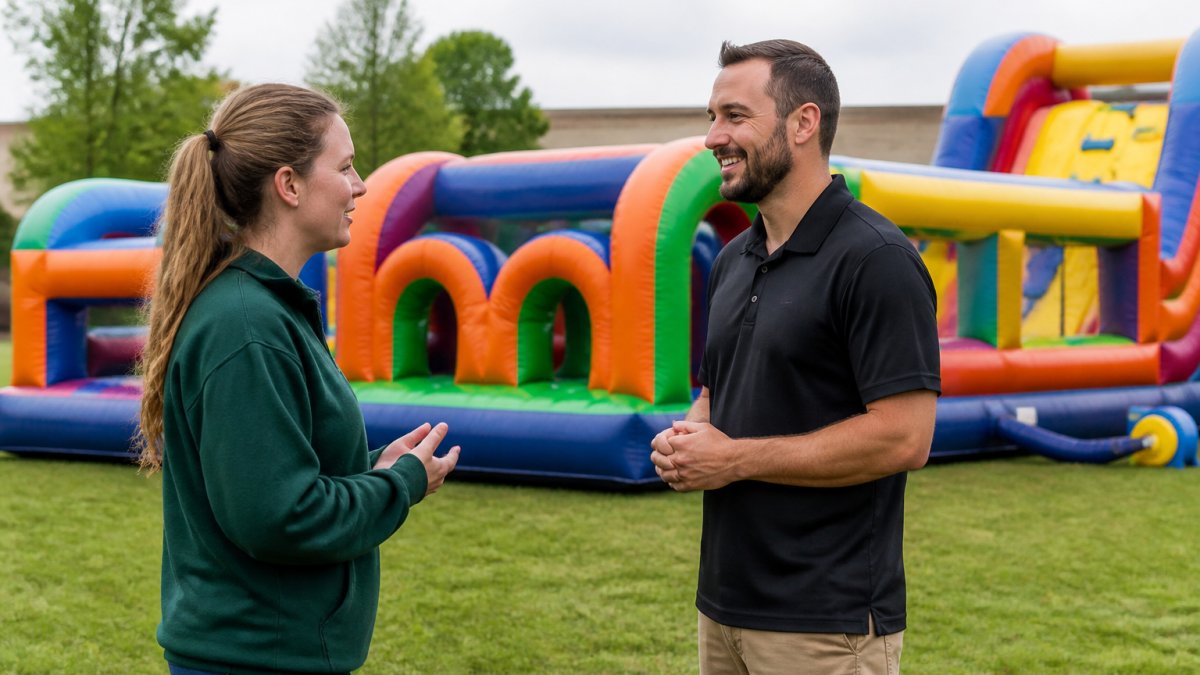
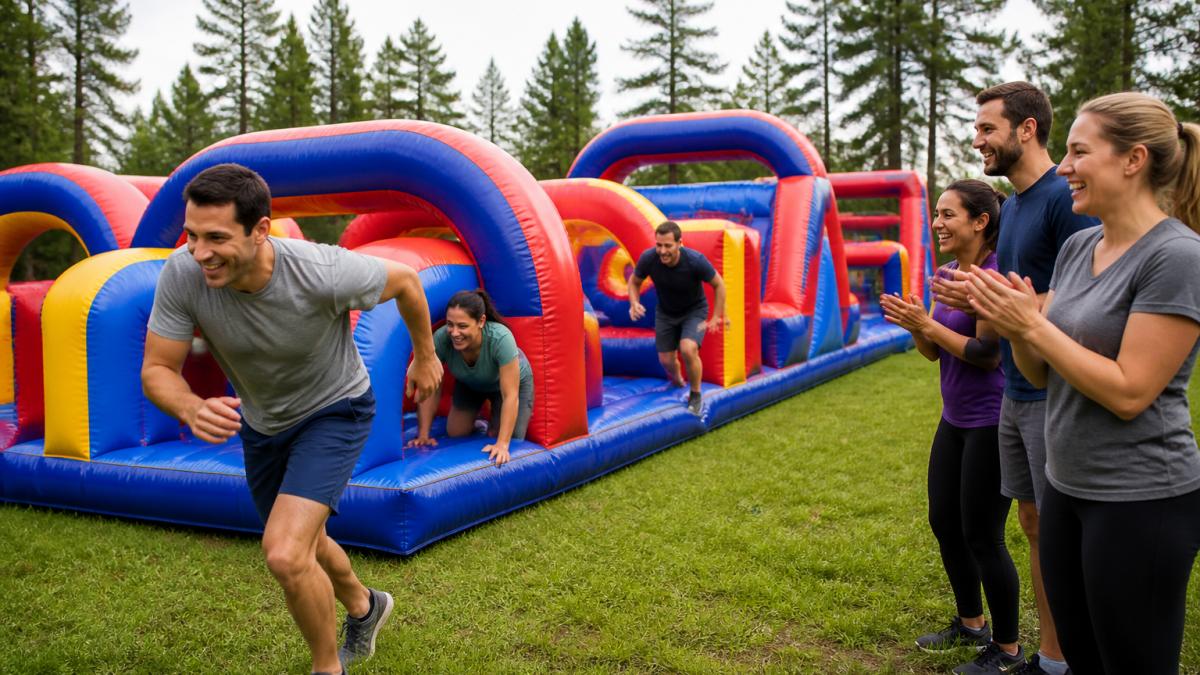
Nothing breaks the ice faster than a grown adult belly-crawling through an inflatable tunnel while their boss cheers them on.
You can run timed heats, department-versus-department relays, or a casual open-play format. If you are weighing game options and want to understand what rental pricing looks like before committing, our bounce house rental pricing guide walks through the factors that shape a quote.
Best for big teams and mixed energy levels
Large groups with many ages and energy levels get the most out of inflatables. If your guest list spans twenty-somethings to longtime veterans who prefer a lawn chair, our party rentals for mixed age groups guide covers options that keep everyone comfortable.
2. Carnival-Style Interactive Games for Work Events
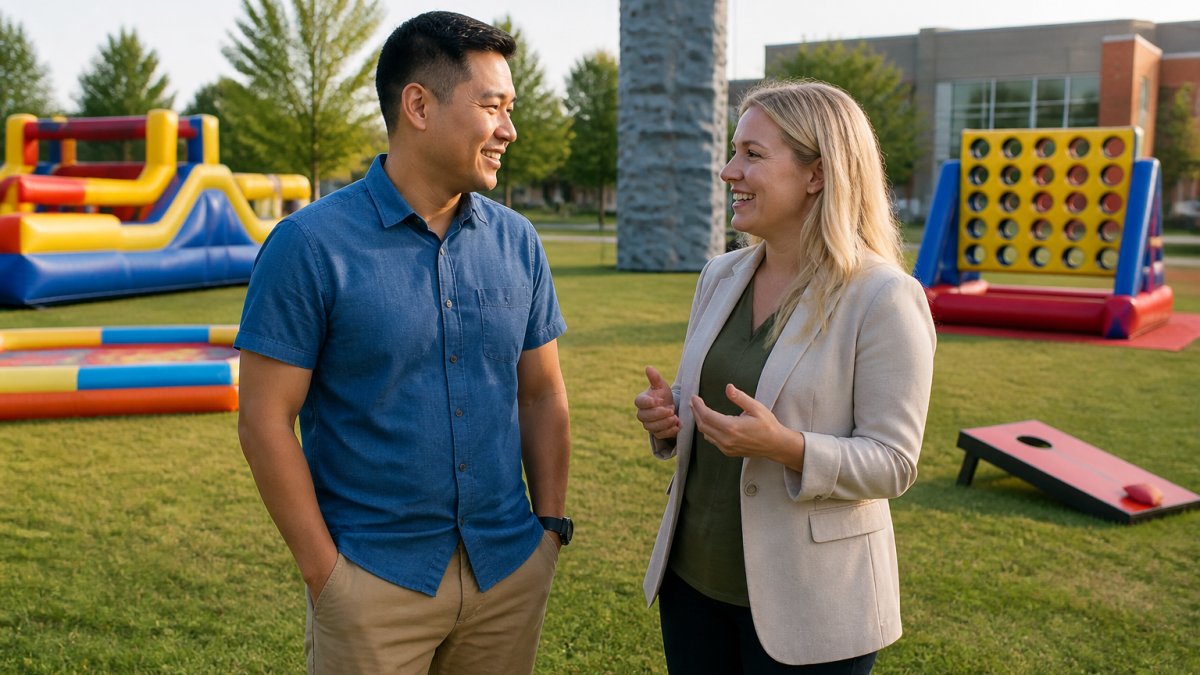
Carnival games hit a sweet spot for office party games: low skill floor, high replay value. Think ring toss, bean bag challenges, and target games that let people rotate through quickly.
These games also suit a happy hour format. Set them up near the food, let people drift over between conversations, and watch the icebreakers happen on their own. No emcee required, no awkward forced participation.
3. Five-Minute Icebreakers for Meetings That Warm Up Any Room
Five-minute icebreakers for meetings are short, low-stakes activities that get people talking before the real agenda starts. The useful part is the mechanics: which format fits which room, how to run it without singling anyone out, and how to make a hybrid group feel like one room instead of two.
Pick the format by what you want the room to do
| Goal | Format | Time | Group Size | What You Need |
|---|---|---|---|---|
| Warm up a quiet room | Human bingo card | 5 min | 15-60 | Printed cards, pens |
| Mix departments fast | Two-truths-and-a-lie, speed-round style | 5 min | 10-30 | Nothing |
| Get people moving | Two-minute team challenge (stack, balance, pass) | 5 min | 20-100 | A few props, open floor |
| Surface shared context | Quick trivia round, mixed-team scoring | 5 min | Any | A host, a scoreboard |
| Break a hybrid divide | Paired virtual/in-person prompt | 5 min | Any | One screen per remote cluster |
Run it so nobody dreads it
- Make participation opt-in. Offer a pass signal so the introverts in the room can watch the first round and join the second.
- Pair, don't spotlight. Two-person prompts get far more voices into the room than a single person at the front.
- Rotate formats. If the same people win the trivia round every quarter, the icebreaker stops breaking any ice.
Hybrid and accessibility notes
For hybrid teams, pair an in-person activity with a virtual game so remote coworkers feel included rather than forgotten. Give each remote cluster its own screen and a designated caller so they are not shouting into a shared laptop. For accessibility, favor seated-friendly formats, keep print large enough to read at arm's length, and avoid activities that require standing, stairs, or quick movement unless you offer a seated alternative.
When to skip the icebreaker entirely
If the group already knows each other, a five-minute warm-up can feel like filler. Swap it for a short game station that runs during the social hour instead, so people opt in on their own schedule. That is often the better call for a holiday celebration or a backyard party rentals Flagstaff gathering where the point is mingling, not structured play.
4. Corporate Team Building Games That Actually Get People Talking
Corporate team building games earn their keep when they force communication instead of just filling time. Scavenger hunts, escape-room-style puzzles, and collaborative challenges all demand that people talk, plan, and divide tasks.
The mistake most planners make is picking a game that rewards the loudest person. Our guide on whether party rental companies handle setup and takedown answers that directly.
5. Large Group Corporate Event Activities That Scale Up Cleanly
Large group corporate event activities fail when they create long lines and idle time. The fix is parallel play: multiple stations running at once so nobody waits.
Plan one station per fifteen to twenty guests, and keep each activity short enough to rotate through. For company picnics and community celebrations in Northern Arizona, we set up kid zones and game areas that keep families moving all afternoon.
6. How to Choose Games by Group Size, Space, and Event Goal
Choosing games by group size, space, and event goal is the difference between a hit and a headache. Most idea lists stop at the table below. The part that actually saves a planner's week is what comes after: matching the game to a measurable objective, confirming the site will work, and booking on a timeline that leaves room for a Plan B.
Start with the size-and-space table
| Group Size | Space Needed | Best Game Type | Event Goal |
|---|---|---|---|
| Under 25 | Small lawn or lot | Icebreakers, trivia | Warm up the room |
| 25-75 | Medium open area | Carnival stations, relays | Mix departments |
| 75-150 | Large field | Obstacle courses, multi-station | High-energy engagement |
| 150+ | Full open space | Rotating stations, open play | Scale without lines |
Then map the game to an objective you can actually check
Pick one objective before you pick a game, then decide in advance how you will know it worked.
- Onboarding and new-hire mixing. Goal: new employees talk to people outside their team. Pick paired or rotating formats. Check it by asking how many new hires met someone from another department.
- Cross-functional collaboration. Goal: people from different teams solve something together. Pick puzzle or scavenger formats with assigned roles. Check it by watching whether the same two people dominate every group.
- Communication. Goal: teams practice giving and receiving clear instructions. Pick blindfolded-guidance or build-to-spec challenges. Check it by debriefing one round on what instructions worked.
If leadership cannot name the objective, pick morale and engagement, it is the safest default and the easiest to measure with a quick survey.
Confirm the site before you commit
Measure the space, then walk the actual spot. Ask about surface type (grass, turf, asphalt, gravel), slope, overhead clearance, and gate or doorway width for delivery access. Confirm whether power is available on site or whether the setup is self-contained. For city parks and property, confirm the rental company is approved to operate there, our safety verification checklist covers what to ask.
Accessibility and contingency planning
- Offer a seated or low-mobility alternative for every active station.
- Keep walkways clear between stations so guests using mobility aids can move through the space.
- Have a weather plan. Flagstaff afternoons can turn, so identify an indoor or covered fallback and confirm with the rental company how a weather call is handled.
Book on a timeline, not on a whim
A practical pattern most planners follow:
- Six to eight weeks out: confirm date, headcount, objective, and site.
- Four to six weeks out: request a quote, confirm availability, and lock the game mix.
- Two weeks out: confirm delivery window, setup location, and the on-site contact.
- One week out: send the internal run-of-show and the weather fallback to attendees.
Ask about deposits, rescheduling, and cancellation terms before you sign, those terms vary by company, and they matter most when a date moves. Popular fall and spring weekends fill first, so book early for company picnics, holiday celebrations, and NAU event and party rentals.
A quick note on renting versus buying
If your company runs one or two events a year, renting beats storing a garage full of games you use twice. Renting also means setup, takedown, and safety checks are handled by the crew, and you are not responsible for storing or maintaining the equipment between events. If you are planning a recurring quarterly series, talk to the rental company about what makes sense for repeat dates.
7. Red Flags When Booking Game Rentals in Northern Arizona
Booking game rentals in Northern Arizona comes with a real risk: fly-by-night operators who look legitimate online but are not insured, not approved by the city, and priced too good to be true.
Ask three questions before you book. Is the company insured? Are they approved to operate on city parks and property? Our safety verification checklist walks through exactly what to ask, and our guide on what to look for in party rental companies covers the rest.
Planning a corporate event that people actually remember takes the right games, the right space, and a rental partner who shows up on time.
Frequently Asked Questions
What are some good interactive games for the workplace?
Carnival-style games, giant yard games, inflatable obstacle courses, and trivia formats all work well because they let people play in short bursts instead of sitting through a long activity. For an office setting, pick games that need limited space and can rotate players quickly. If you have outdoor space, inflatables and oversized lawn games draw a crowd on their own. The right pick depends on how many people you have and whether you want spectators involved or everyone playing at once.
How do you choose interactive games for a corporate event?
Start with three numbers: headcount, available space, and how long you want the activity to run. Then match the game to the goal. If the point is meeting new people, lean on icebreakers and rotating team games. If the point is a morale boost, go for spectacle like obstacle courses or a carnival setup. Ask your rental company what fits your footprint before you commit, since setup space varies by item.
How long should corporate event games last?
Most groups do best with games in 10 to 20 minute blocks, with open play areas running for an hour or more during a picnic or happy hour. Short icebreakers work at five minutes or less. Build in buffer time for people to wander over, sign a waiver if needed, and rotate through. A game station that runs the whole event usually gets more total participation than one scheduled tournament.
What games work well for large groups at company events?
Large group corporate event activities need to keep lines moving. Inflatable obstacle courses, multi-lane racing games, carnival booths, and giant yard games handle steady rotation better than single-player setups. For 100 or more people, plan several stations running at once so nobody stands around waiting. Ask about delivery and setup timing so everything is ready before your start time.
How can you make corporate event games inclusive for different personalities?
Offer a mix of active and low-key options. Some people want to race through an obstacle course; others would rather play a lawn game or watch. Keep team games non-elimination so nobody sits out early, and avoid formats that force public speaking. Having a spectator-friendly layout lets quieter attendees participate on their own terms without feeling singled out.