 Ultimate guide
Outdoor Event Planning Checklist 2026: Your Step-by-Step Guide
Last Updated: November 15, 2026
Quick Summary
An outdoor event planning checklist for 2026 works in three phases: goals, budget, and guest list first; then venue, permits, and vendors; then setup, event day, and teardown. Start 9-12 months out for large events, build in a 10 to 15 percent contingency fund, and write a weather plan with triggers and decision deadlines before event week.
- Book venue, tent, and major rentals 6-9 months before the event date.
- Confirm vendors, permits, and insurance in the 4-6 month window.
- Set a wind trigger in advance and weight every tent leg and canopy.
- Wait at least 30 minutes after the last thunder before resuming activities.
- Sketch one accessible route from parking to seating, food, and restrooms.
Table of Contents
- Why an Outdoor Event Planning Checklist Saves Your Sanity
- How Far in Advance to Plan an Outdoor Event
- Your Outdoor Event Planning Checklist 2026 Template
- Building an Outdoor Event Weather Contingency Plan
- Essential Rental Equipment for Outdoor Events
- Site Layout, Accessibility, and Guest Flow
- Corporate Event Planning Checklist PDF: What to Include
- Book Your Flagstaff Outdoor Event Rentals Early
- Frequently Asked Questions
Why an Outdoor Event Planning Checklist Saves Your Sanity
An outdoor event planning checklist is a written, phase-by-phase list of every decision, booking, and setup task that has to happen before guests arrive.
Below is a full outdoor event planning checklist for 2026, from the first budget conversation to the last folding table going back on the truck.
How Far in Advance to Plan an Outdoor Event
Plan a small outdoor gathering several weeks ahead, and start earlier for anything with vendors, permits, or a large guest list.
For Northern Arizona, if your event lands on a graduation weekend, a holiday, or a fall festival Saturday, treat it like a wedding and start early.
The 12-Month Timeline at a Glance
| Time Before Event | What to Do |
|---|---|
| 9-12 months | Set goals, budget, guest count, and date range |
| 6-9 months | Book venue, tent, and major rentals |
| 4-6 months | Confirm vendors, permits, and insurance |
| 2-3 months | Send invitations, plan layout, reserve backup options |
| 2-4 weeks | Finalize headcount, delivery times, and staffing |
| Event week | Confirm weather plan, do a walkthrough, pack the kit |
| Event day | Setup, execute, teardown |
Your Outdoor Event Planning Checklist 2026 Template
Here is the working template we would hand a friend. Copy it, print it, tape it to the fridge. It is built around three phases, and each phase has a clear job.
Phase 1: Goals, Budget, and Guest List
Start with three questions: what is this event for, who is coming, and what does success look like? A graduation party for 30 people and a company picnic for 200 have almost nothing in common except the word "party."
Write down your event purpose, audience, and rough guest count, then set a budget with a 10 to 15 percent contingency fund so a surprise rental or extra ice run does not wreck the plan. Before you commit to numbers, see what party rentals typically cost so your budget reflects reality.
Two things people often forget: dietary needs and accessibility. Ask about both early, while you can still change the menu and layout.
Phase 2: Venue, Permits, and Vendors
Choose a venue you have actually stood on. Do a site inspection and check terrain, shade, parking, restroom access, and power supply.
Then confirm what the site requires. If you are unsure whether delivery crews handle the heavy lifting, see how setup and takedown work before you sign anything.
This is also where you vet who you are hiring.
Phase 3: Setup, Event Day, and Teardown
During the event, do a mid-point walk-through. Check restrooms, sanitation, and trash. Keep a small tool kit, extra tape, and a printed emergency plan with contacts on hand.
Teardown deserves a plan too: know who breaks down what, where equipment gets stacked for pickup, and how you will handle waste.
Building an Outdoor Event Weather Contingency Plan
Every outdoor event needs a weather contingency plan that covers more than rain. Wind, heat, cold, smoke, lightning, and sudden monsoon storms all change the plan, and Flagstaff's high-country climate can deliver several in one afternoon. Write your triggers and actions down before event week so nobody is making big calls while guests are already parking.
Write Your Triggers and Decision Deadlines First
A trigger is the specific condition that flips you from Plan A to Plan B. A decision deadline is the time by which the call gets made, no debate.
A practical pattern many planners use:
- 72 hours out: check the forecast and confirm your tent hold, backup indoor option, and vendor rain policies. Decide whether to add sidewalls or extra weighting.
- 24 hours out: confirm the go/no-go call time (often the morning of, sometimes the night before for morning events), send guests the weather note, and stage extra tarps, weights, and towels.
- Morning of: final forecast check, walk the site, confirm generator fuel and cable safety, and lock the decision deadline in writing.
Watch out: a "we'll figure it out" plan usually means the tent crew, the caterer, and the DJ all make different calls at once, and the guest experience falls apart in the gap.
Heat, Cold, and Sun
Hot afternoons are the most common outdoor problem in Northern Arizona, and shade is the fix.
Cold swings are real at elevation, especially for fall weddings and evening events. Because weather plans also depend on clear roles and timing, the same coordination that keeps guests comfortable outdoors matters when producing New Orleans Music Events.
Wind
Wind is the sneaky one: it takes tablecloths, tips over unweighted canopies, and turns paper plates into projectiles.
Watch out: an unweighted pop-up canopy in a gust can become a hazard, and if the operator was not insured or approved for the site, the liability can land on you.
Lightning and Severe Storms
Lightning is a hard stop, not a judgment call. When thunder is heard or lightning is visible, move guests into a substantial building or a hard-topped vehicle, and wait at least 30 minutes after the last thunder before resuming (Overview: Lightning Safety). Tents are not lightning shelters.
Smoke, Air Quality, and Wildfire Season
Wildfire smoke and poor air quality can cancel an outdoor event even on a blue-sky day. Check the air quality index the morning of, set a threshold for moving activities indoors or postponing, plan for sensitive guests, kids, and older attendees, and keep the tent option open with sidewalls to cut smoke exposure.
Your Backup Plan Needs Three Parts
Name a physical alternative (a tent with sidewalls, a covered pavilion, a garage, or an indoor room), a communication method (a group text, a social post, a sign at the entrance), and a decision deadline. For extra protection, affordable tent rentals in Flagstaff can turn an open yard into a covered venue without a last-minute scramble.
Build a Weather Kit
Pack one bin you can grab in the dark: extra weights and stakes, tarps, towels, a battery-powered radio, flashlights, a phone charger, trash bags, and a printed copy of the plan with vendor and emergency contacts. Keep it near the entrance so anyone can find it.
Essential Rental Equipment for Outdoor Events
The core rental list for an outdoor event covers shelter, seating, surfaces, and entertainment.
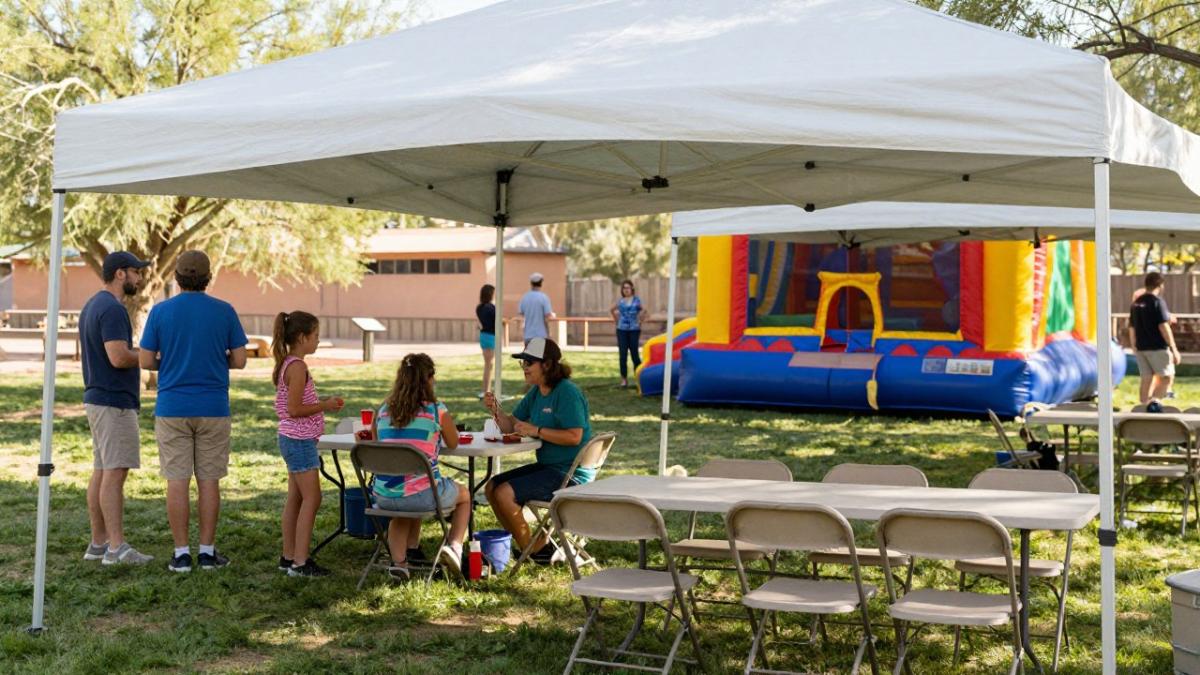
Run through these categories before you book anything:
- Shelter: tent or canopy for sun and rain cover
- Seating and surfaces: tables, chairs, linens, dance floor
- Shade and cooling: umbrellas, misting options for hot afternoons
Renting often makes more sense than buying for hosts who only need equipment occasionally, since you avoid storing large items between events.
Site Layout, Accessibility, and Guest Flow
Lay out your site before the trucks arrive. Sketch the entrance, food zone, seating, activity areas, restrooms, and parking, then walk the path a guest with a stroller, a wheelchair, or a walker would take. If that path hits gravel, a step, or a narrow gap, fix it now.
Start With a Walkable Route
Draw one primary accessible route from parking to the entrance, then to seating, food, restrooms, and at least one activity.
Watch out: a route that works at 2 p.m. can fail at 8 p.m. when the grass is wet and the light is low. Walk it again after setup and add lighting or glow markers.
Terrain and Surfaces
A grassy park, a gravel lot, and a sloped backyard each demand different equipment. Check for slope, drainage, roots, and rocks before you place tables or a dance floor: on a slope, put seating and food on the flattest ground and keep the dance floor level; on gravel, add a solid surface under tables and chairs; and if the site drains poorly, keep the tent and food zone off the low spot.
Accessible Restrooms and Seating
Plan restrooms that work for everyone: an accessible unit with a flat approach, a grab bar, and enough turning space, plus a handwashing station at a reachable height. Seat guests who cannot stand long near the food and the shade, leave open space beside tables for wheelchairs and walkers, and keep a few chairs without arms so transfers are easier.
Sensory and Inclusive Considerations
Loud speakers, flashing lights, and crowded lanes are hard on kids, older guests, and anyone with sensory sensitivities. Put a quiet zone away from the speakers, aim sound at the crowd instead of across the whole site, and give people a clear way to step out.
Guest Flow and Bottlenecks
Guest flow is about avoiding pileups. Keep the buffet away from the entrance, leave clear lanes between tables, put high-traffic activities at the edges so they do not block the middle, separate the drink station from the food line, and put trash and recycling next to the exits. Mixed-age crowds need extra thought, and rental ideas for mixed age groups can help you place activities so the little kids and the grandparents are both comfortable.
Parking, Drop-Off, and Lighting
Mark a drop-off spot close to the entrance for guests with limited mobility and keep it clear of vendor trucks.
Accessibility also means shade, seating for people who cannot stand long, and restrooms that work for everyone. Plan it on paper and it costs nothing.
Corporate Event Planning Checklist PDF: What to Include
A corporate event planning checklist PDF should include goals and success metrics, budget and approval chain, venue and permits, vendor contracts, staffing and roles, a run-of-show timeline, a risk assessment, and a post-event evaluation form.
The corporate version differs from a family party in three ways: approvals, documentation, and reporting. Add an event proposal summary, a named event lead, a clear escalation path for problems, food safety notes, insurance certificates from every vendor, and a sign-in process for guests.
Save the final version as a PDF and share it with everyone from the facilities team to the caterer. One document, one source of truth.
Book Your Flagstaff Outdoor Event Rentals Early
The best checklist in the world cannot fix a sold-out Saturday.
Before you put down a deposit, know what to look for in a party rental company: confirm the business is insured, approved for the sites you are using, and clear about delivery windows and setup.
Whether you are planning a backyard birthday, an NAU graduation celebration, a wedding, or a company picnic, we would love to help you build the rental list.
Planning an outdoor event in Northern Arizona means juggling weather, terrain, and a guest list that keeps growing.
Frequently Asked Questions
What are the 7 stages of event planning in order?
The seven stages run in a clear sequence: define goals and audience, set the budget, choose the venue, build the timeline, book vendors and rentals, run the event, and evaluate afterward. An outdoor event planning checklist 2026 should follow this order so nothing gets skipped. Most planners add a weather contingency review between the vendor stage and event day, since outdoor events carry risks indoor venues do not.
How far in advance should you plan an outdoor event?
For a small backyard gathering, four to six weeks is workable. For weddings, graduations, and corporate picnics, start six to twelve months out. Peak spring and fall weekends in Flagstaff book fast, so reserve tents, tables, chairs, and inflatables as soon as your date is set. Booking early also gives you time to confirm permits and build a weather backup plan without rushing.
What should be in an outdoor event weather contingency plan?
Cover more than rain. List wind thresholds for tents and inflatables, a lightning evacuation route, a heat plan with shade and water stations, and a cold-weather plan with heaters and blankets. Name who makes the call to move or cancel, and set a decision deadline. Flagstaff weather shifts quickly, so check the forecast daily in the final week and confirm your rental company's weather policy in writing.
What equipment do you need for an outdoor event?
Core categories include tents for shade and rain cover, tables and chairs, lighting for evening events, a sound system, power supply or generator, restroom and sanitation options, trash and recycling bins, and inflatables or games for family events. Add a first-aid kit and signage for guest flow. Make a checklist of every category and confirm quantities against your guest count before booking.
How do you keep guests comfortable at an outdoor event?
Shade, water, and seating do most of the work. Set tents and shade structures where guests gather, place water stations throughout the site, and provide enough seating for older guests and anyone who needs to rest. Plan restroom access, add lighting for evening hours, and create a clear guest flow so people are not crowded in one spot. A site walk-through a week before the event catches problems early.
How do you avoid uninsured or fly-by-night rental companies?
Ask for proof of insurance and confirm the company is approved for the venues you are using, especially city parks. A legitimate Flagstaff rental business will share documentation without hesitation. Be wary of prices that seem too good to be true, no written contract, or no physical address. Confirm delivery, setup, and teardown terms in writing so event day runs smoothly.